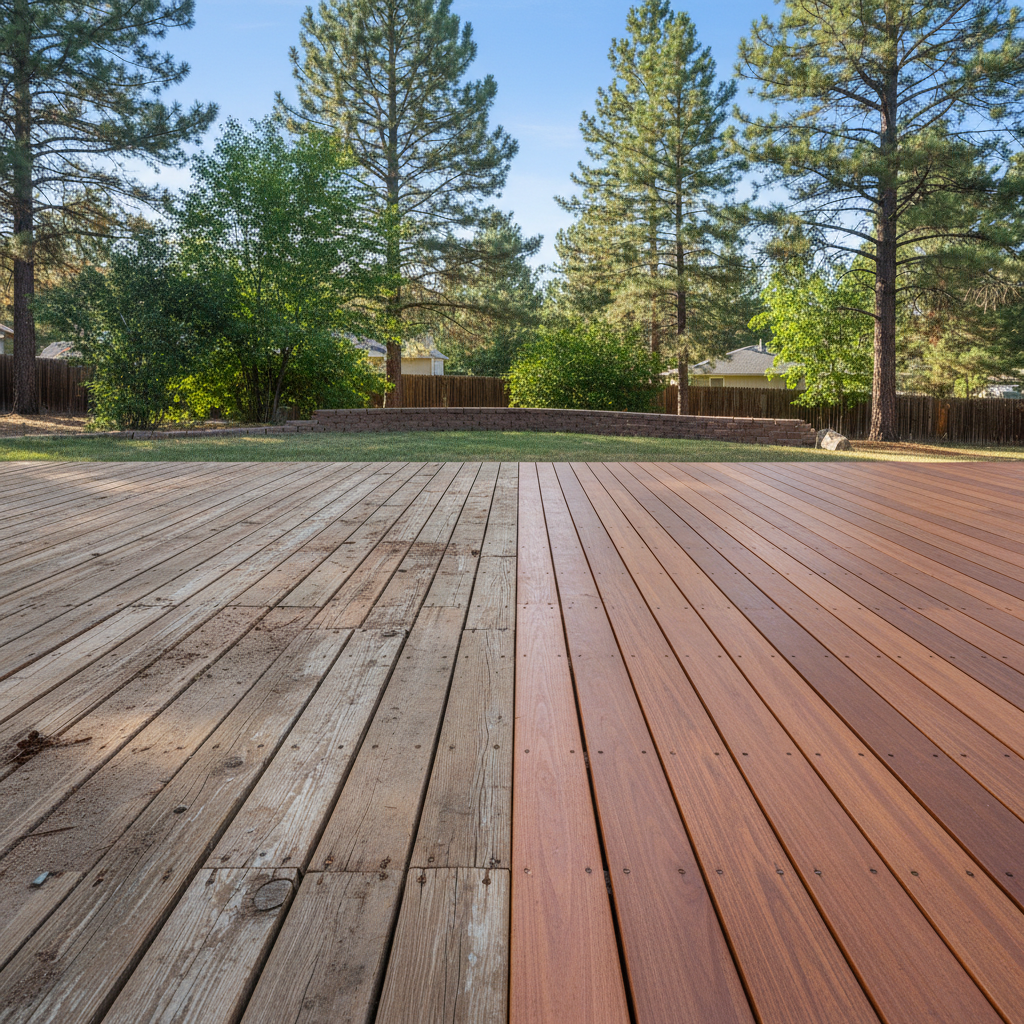
You're out on your deck, soaking up that Flagstaff sunshine (or maybe ducking a summer monsoon), and then you see it: a few rotten boards, some splintering, or a railing post that's definitely seen better days. Immediately, your brain goes, "Ugh, how big a headache is this going to be?"
When your deck's taken a hit, you usually have two main options: you can either patch up just the bad spots, or you can go for a full resurface. Both approaches have their place, but knowing which one makes sense for your particular situation here in Flagstaff could save you a ton of grief and money down the line. Believe me, I've seen countless decks up here, from Kachina Village all the way to Forest Highlands, and our weather really does a number on them.
Spot Repair: Just Replace the Bad Stuff
This is pretty much what it sounds like. You find the individual boards, railing sections, or stair treads that are damaged and just swap those out. It's often the first thing folks consider because, well, it seems like the quickest, cheapest fix.
Cost: Generally, this is the cheapest option upfront. You're only buying a handful of boards, some fasteners, and paying for minimal labor. If you're handy, you might even tackle it yourself.
Durability: Here's where it gets a little tricky. If the *reason* for the damage (like bad drainage, constant wetness, or an old, failing substructure) isn't fixed, those new boards could go bad just as fast as the old ones. Plus, if the boards around them are also old, they're probably not far behind. It’s kind of like putting one new tire on a car when the other three are bald, you know?
Maintenance: You'll need to make sure the new boards match the old ones in material and finish, otherwise you'll end up with a patchwork look. And you'll still be doing regular upkeep on the rest of the deck.
Appearance: Unless you manage to replace them with perfectly matched, aged material (which is super hard to do), you're going to notice a difference. New wood looks new, and old wood looks old. It can really stick out, especially if your deck is stained.
When it makes sense: If your deck is fairly new (say, under 5-7 years old), the damage is truly isolated (like one board got whacked by something, or a single post rotted because of a specific leak), and the rest of the deck is in fantastic shape, then a spot repair can be a good choice. It's a band-aid, sure, but sometimes a band-aid is all you need.
Full Resurfacing (Redecking): New Surface, Old Frame
With this approach, you keep the deck's existing frame (that's the joists, beams, and posts holding everything up) but replace all the decking boards, railings, and usually the stairs too. Essentially, you're giving your deck a brand-new top layer.
Cost: It's more expensive upfront than a spot repair, but usually a lot less than building an entirely new deck. You're reusing the most costly and labor-intensive part: the foundation. This is also a great time to upgrade materials, like switching from wood to composite decking, which we do a ton of at Flagstaff Deck Creations.
Durability: If your frame is solid, this option basically gives you a new deck. You get the full lifespan out of your new decking material. This is especially helpful for Flagstaff, where our freeze-thaw cycles and heavy snow can really beat up wood. Using a tough composite or properly treated wood will give you years of worry-free enjoyment.
Maintenance: This is a huge bonus, especially if you go with composite decking. You're looking at way less maintenance – no more annual staining or sealing. If you stick with wood, you'll still have some upkeep, but it'll be on a fresh, uniform surface.
Appearance: You get a totally fresh, consistent look. It's like getting a brand-new deck without the brand-new deck price tag. You can change the color, the material, even the style of the railing. It really transforms your outdoor space, doesn't it?
When it makes sense: If your deck frame is still in good condition (no major rot, stable, properly spaced joists), but the surface boards, railings, or stairs are showing widespread wear, rot, or just look tired, resurfacing is almost always the smarter long-term investment. It fixes the aesthetic problems and gives you a durable, uniform surface that will last for years.
My Recommendation for Flagstaff Homeowners
For most folks in Flagstaff, especially if your deck is over 10-15 years old and showing several signs of wear, I'm going to lean towards a full resurfacing. Why?
Our climate is just plain tough on decks. The intense sun at our elevation, those heavy snow loads, and the wild temperature swings from summer to winter mean that if a few boards are bad, chances are the others aren't far behind. Trying to chase down every failing board with spot repairs can turn into a never-ending cycle, costing you more time and money in the long run.
Resurfacing lets you start fresh with the decking material. You can upgrade to a low-maintenance composite that holds up incredibly well to our conditions, or put down new, properly treated wood that will last. You get a consistent, beautiful look, and you can relax knowing your deck is solid for years to come.
Before you decide, get a professional to inspect your deck's frame. That's the crucial part. If the frame is shot, then you're looking at a full replacement anyway. But if it's sound, resurfacing is often the smartest move for a beautiful, durable deck that you'll actually enjoy for decades.